

- April 13, 2026
- Quantum
- 0
Author: Ronen Shekel
Quantum entanglement stands as one of the most profound and practically significant phenomena in modern physics. In communication, entangled photons enable quantum key distribution schemes whose security is guaranteed by the laws of physics, rather than by assumptions about computational hardness. In computation, large entangled states are what allow quantum algorithms such as Shor’s to threaten many of today’s cryptographic standards once scalable quantum processors exist. Many of these applications rely on entangled photon pairs, so having robust and well-controlled sources of entanglement is a central ingredient.
When photon pairs are generated via spontaneous parametric down-conversion (SPDC), certain types of entanglement arise naturally from conservation laws. Energy conservation couples the photon frequencies, yielding time–frequency entanglement. Momentum conservation links their emission directions, creating spatial entanglement. However, polarization is different. Standard nonlinear interactions typically produce pairs with well-defined polarizations, such as |HH> or |HV>, rather than the coherent superposition required for entanglement. To achieve a state like |HH>+|VV>, one must engineer two distinct SPDC processes and erase any distinguishing information (time, spectrum, or spatial mode) that could reveal which process occurred.
From rings and crossed crystals to interferometers
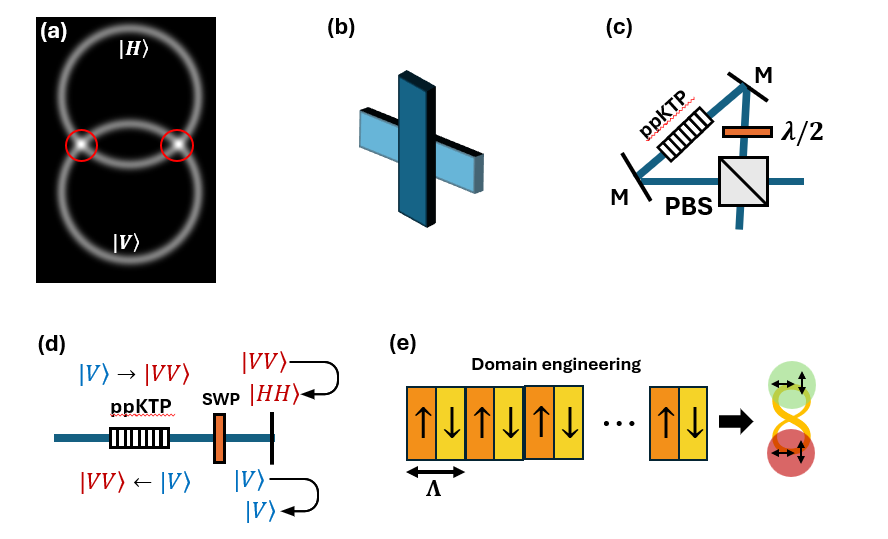
One of the earliest demonstrations was the non-collinear, type-II BBO source by the Zeilinger group in 1995 [1]. Photons emerge on two intersecting cones, one for each polarization (Fig. 1a). By collecting light only from the two overlap regions, the two possible generation paths become indistinguishable. While elegant, this method discards the vast majority of the flux, resulting in low brightness.
To use the full flux of the crystal, collinear schemes were introduced. In the crossed-crystal configuration [2], two thin periodically poled crystals are placed back-to-back with their optic axes rotated by 90° (Fig. 1b). Pumped with a beam at 45° polarization, one crystal generates |HH> pairs and the other |VV> pairs. If these two contributions are made indistinguishable apart from their polarization, the output is a coherent superposition |HH>+|VV>. In practice, additional compensation crystals are needed to erase timing information that may distinguish between the two crystals. Related collinear sources [3] combine a single crystal with a beam splitter and use post-selection at the output, at the cost of half the signal.
A next step was to keep a single crystal but let the pump traverse it twice. In Sagnac interferometer sources [4, 5], the pump enters a polarization Sagnac loop and propagates clockwise and counter-clockwise through the crystal, with each direction generating one of the two processes (Fig. 1c). A “folded sandwich” geometry (Fig. 1d) implements a similar double-pass through a linear interferometer [6]. While these designs produce bright sources, they still rely on interferometers, beam splitters and mirrors that must be aligned and kept mechanically stable.
Let the poling do the heavy lifting
An alternative approach [7] is to move this complexity inside the nonlinear medium itself (Fig. 1e). By choosing the periodic poling and phase-matching conditions appropriately, a single ppKTP crystal can support both SPDC processes in a single pass, avoiding external interferometers. In a recent collaboration involving Raicol crystals, Shukhin and co-workers improve on this, using a domain-engineered KTP crystal to generate polarization entanglement, and at the same time shape the joint spectral intensity (JSI) [8].
The concept relies on a carefully designed poling pattern that supports two distinct collinear type-II SPDC processes simultaneously. Both processes share the same spatial mode but differ in polarization and frequency. By shaping the phase-matching function via the internal domain structure, the source produces a JSI with circular lobes. This shaping suppresses spectral correlations, rendering the photons spectrally factorable – a critical requirement for high-purity heralded single photons and for entanglement swapping from independent sources. The fact that the properties of the generated photons are dictated by the internal poling structure results in a compact, stable and reliable source that achieves high Bell-inequality violations (S~2.75) and high visibility without post-selection or delicate alignment.
At Raicol, we view this as the evolution of nonlinear crystal technology: moving from simple phase matching to full quantum state engineering. If you are interested in custom domain engineering to tailor entanglement structure or spectral purity, please contact us to discuss the possibilities.
[1] Kwiat, Paul G., Klaus Mattle, Harald Weinfurter, Anton Zeilinger, Alexander V. Sergienko, and Yanhua Shih. “New high-intensity source of polarization-entangled photon pairs.” Physical Review Letters 75, no. 24 (1995): 4337.
[2] Pelton, Matthew, Philip Marsden, Daniel Ljunggren, Maria Tengner, Anders Karlsson, Anna Fragemann, Carlota Canalias, and Fredrik Laurell. “Bright, single-spatial-mode source of frequency non-degenerate, polarization-entangled photon pairs using periodically poled KTP.” Optics Express 12, no. 15 (2004): 3573-3580.
[3] Kuklewicz, Christopher E., Marco Fiorentino, Gaétan Messin, Franco NC Wong, and Jeffrey H. Shapiro. “High-flux source of polarization-entangled photons from a periodically poled KTiOPO 4 parametric down-converter.” Physical Review A 69, no. 1 (2004): 013807.
[4] Weston, Morgan M., Helen M. Chrzanowski, Sabine Wollmann, Allen Boston, Joseph Ho, Lynden K. Shalm, Varun B. Verma et al. “Efficient and pure femtosecond-pulse-length source of polarization-entangled photons.” Optics express 24, no. 10 (2016): 10869-10879.
[5] Kim, Heonoh, Osung Kwon, and Han Seb Moon. “Pulsed Sagnac source of polarization-entangled photon pairs in telecommunication band.” Scientific reports 9, no. 1 (2019): 5031.
[6] Steinlechner, Fabian, Sven Ramelow, Marc Jofre, Marta Gilaberte, Thomas Jennewein, Juan P. Torres, Morgan W. Mitchell, and Valerio Pruneri. “Phase-stable source of polarization-entangled photons in a linear double-pass configuration.” Optics express 21, no. 10 (2013): 11943-11951.
[7] Laudenbach, Fabian, Sebastian Kalista, Michael Hentschel, Philip Walther, and Hannes Hübel. “A novel single-crystal & single-pass source for polarisation-and colour-entangled photon pairs.” Scientific reports 7, no. 1 (2017): 7235.
[8] Shukhin, Anatoly, Inbar Hurvitz, Leonid Vidro, Ady Arie, and Hagai S. Eisenberg. “Direct polarization-entangled photon pair generation using domain-engineered nonlinear crystals.” Optica Quantum 3, no. 5 (2025): 487-494.
Raicol
Rosh Ha’Ayin 4809162, Israel